Wooden pallets, the fundamental building blocks of logistics and warehousing operations, may look similar from the outside but differ greatly in terms of engineering and capacity. Especially in high-tonnage sectors such as heavy industry, automotive, chemical, or casting, choosing the wrong packaging can lead to product damage, warehouse accidents, and breaks in the supply chain.
One of the most frequent dilemmas for businesses is: Should we use Euro pallets or standard wooden pallets? In this guide, we examine the structural differences between both pallet types, the carrying capacity limits of Euro pallets, and which option is ideal for automated rack systems.
Structural and Certification Differences: The UIC 435-2 Norm
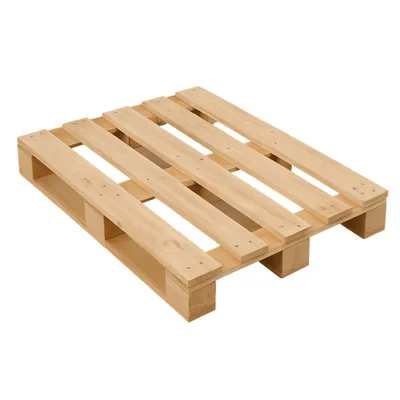
For a pallet to earn the “Euro” title, it is not enough for it to be assembled from boards cut to specific dimensions. EPAL pallet specifications are subject to UIC 435-2 production norms established by the European Pallet Association and valid worldwide.
Material and Thickness: In an original Euro pallet, the board thicknesses must be exactly 22 mm. The nail patterns, wood type, and moisture content are constantly checked by independent auditors.
Standard Wooden Pallet: In standard pallets, production dimensions and wood thicknesses are left entirely to the customer’s request or the manufacturer’s initiative. There is no specific international quality audit mechanism (unless ISPM-15 is specifically requested).
Performance Under Load: Static and Dynamic Carrying Capacities
In heavy industry shipments, how many kilograms a pallet can carry is critical data. A product to be used as a heavy-duty pallet must have passed engineering tests.
Euro Pallet Carrying Capacity: An original EPAL pallet has a dynamic load capacity of 1,500 kg for homogeneously distributed loads. When pallets are stacked (static state), this resistance increases up to 4,000 kg.
Standard Pallet Carrying Capacity: Although it varies according to board thickness and block structure, they generally have carrying capacities between 500 kg and 1,000 kg. The risk of flexing or breaking is higher for high-tonnage products.
When the standard 80×120 pallet is insufficient for voluminous industrial loads, large-size 100×120 pallet (Extended Euro/EPAL) solutions that certify carrying capacity come into play.
Why EPAL Must Be Used in Smart Warehouse (ASRS) Systems?
There is no room for out-of-tolerance dimensions, especially in shipments to the European market and fully automated rack systems (ASRS). The efficient operation of your multi-million dollar automation investment depends on the millimeter accuracy of the wooden pallet on top of it.
Original EPAL licensed products work with 100% efficiency in robotic palletizer machines and automatic conveyor lines without hanging or jamming. If standard or unlicensed (counterfeit) pallets are used, sensors perceive millimeter deviations or protruding nails as errors; the system stops and operational paralysis occurs.
Sermur Palet: Engineering Power in Both Standard and Boutique Solutions
As Sermur Palet, we flawlessly produce licensed and ISPM-15 certified EPAL pallets compliant with European standards on our fully automatic lines. However, we know that in heavy industry, not every product fits into the standard Euro pallet molds of 80×120 or 100×120.
In cases where standards are insufficient for industrial machines, defense industry products, or casting parts, Sermur Palet’s “Custom Production” engineering takes over.
Custom Size Wooden Pallet: We carry out boutique production by calculating the center of gravity of your load and the G-force it will be exposed to during transport.
Closed wooden Pallet: Our fully closed wooden pallet models, designed specifically to protect the load against forklift impacts and ground moisture, leave no gaps on the top deck.
Frequently Asked Questions
What are Euro pallet dimensions? The standard Euro pallet dimension is 80×120 cm, which is most suitable for European road transport (TIR trailer dimensions). However, large Euro pallets in 100×120 cm dimensions produced to European Pallet Association (EPAL) standards are also available for industrial and voluminous loads.
What is the biggest difference between a Euro pallet and a standard pallet? The most fundamental difference is standardization and licensing. A Euro pallet (EPAL) is produced by being audited according to UIC 435-2 norms, from wood moisture content to the twist count of the nails used, and offers a guaranteed dynamic load of 1,500 kg. Standard pallets are produced according to the specific demand of the business or the manufacturer’s standards without being bound to a specific international norm.
Which pallet should I choose for heavy machinery transport? If your machine fits 80×120 or 100×120 dimensions and its weight does not exceed 1,500 kg, the EPAL pallet is the safest choice. However, if a special machine that is longer or heavier (e.g., 3-4 tons) is to be shipped, a “Custom Size Wooden Pallet” with thick blocks designed specifically for the center of gravity or a “Fully Closed wooden Pallet” that prevents impact from below should be preferred.